
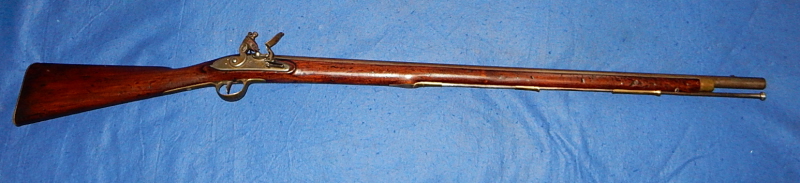
 .65” 1817 Ordnance issue New Land Pattern Junior Cadets Carbine.
£7500 SALE £3950
A very rare .65” 1817 Ordnance issue New Land Pattern Junior Cadets Carbine. Reduced size new land pattern flintlock with ring neck cock and roller steel spring has a Crowned GR to the centre next to a Crowned Broad Arrow Ordnance ownership mark to the underside of the pan. Walnut stock of new land pattern with straight hand stock and swell behind the rear rammer pipe is fitted with brass furniture of reduced new land pattern including the butt plate, trigger guard with single retaining screw to the tang, serpentine side plate, plain nose cap, two rammer pipes, throat pipe and a shied escutcheon to the wrist. The butt plate tang engraved C49, for issue to C Company of the Military College. Ordnance GR ownership stamp to the right side of the stock. Sling swivels removed at some time in its life and button head rammer, probably of later manufacture to the underside of the barrel. 34” pin retained smooth bore barrel with bayonet stud / foresight to the muzzle is struck to the breech with Georgian and also later Victorian Ordnance broad Arrow proof marks with Ordnance inspection marks to the barrel tang and next to the touch hole. First designed in 1812 for issue to the Gentlemen Cadets of the Junior Department of the Royal Military College these scarce muskets were not issued until 1817 alongside a 36” barrel version issued to the Cadets of the Senior Division. Based closely on the design of the then line musket of the army, the New Land Pattern, but about 2/3 of the the size and firing a .65” carbine ball these muskets were used to arm and train the Officer Cadets of the 1820’s and 30’s who in the later Victorian age would go onto become the Colonels and Generals that would lead the Army at the height of its powers, when the British Empire ruled over large parts of the world and controlled even larger areas by means of trade facilitated by her vast merchant fleet, guarded by the all powerful Royal Navy. It was later adopted by the Royal Naval Collage and the Marine Society who trained the officers who would go onto command those ships. In very good condition with good bore and mechanics, a nice sharp stock with Ordnance inspection marks (small chip to the rear of the lock plates tail) and fading brown finish to the metal work. A very nice example of one of the scarcest of the Ordnance issue flintlock muskets that is very rarely seen on the market.


